

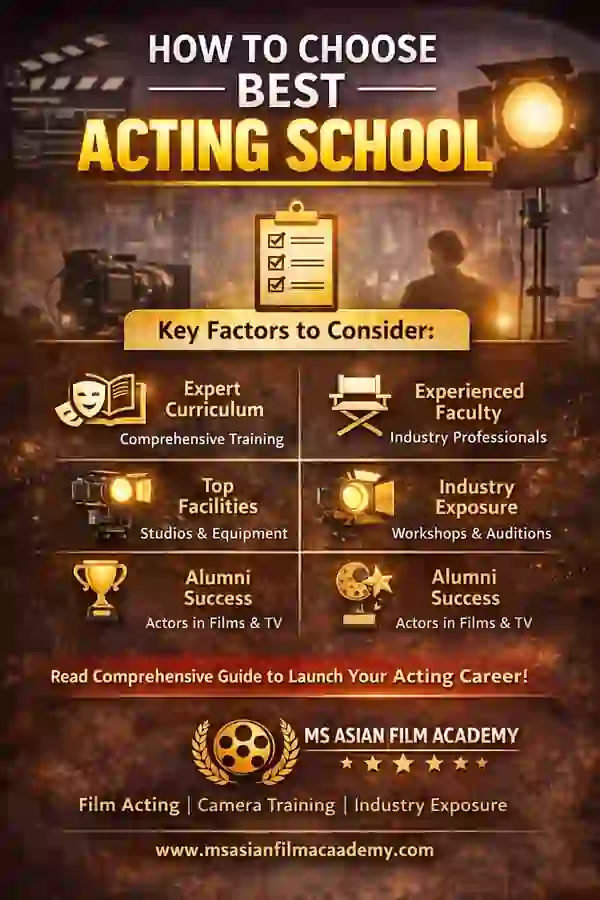
How to Choose the Best Acting School — The Complete 2026 Guide
Choosing the right acting school is one of the most important decisions an aspiring performer can make. The right program can not only sharpen your craft, but also shape your confidence, create lifelong industry connections, and help launch a sustainable career in film, television, theatre, or digital media.
However, picking the “best” acting school isn’t simply a matter of reputation or price — it involves understanding your goals, evaluating curricula, comparing faculty, assessing outcomes, and knowing what kind of environment will help you thrive. In this comprehensive guide, we’ll walk you through every factor you should consider, with examples and clear tips to make an informed choice.
1. Clarify Your Goals Before Anything Else
Before evaluating schools, ask yourself:
- What exactly do I want to train in?
Film acting? Theatre? Commercials? Voice work? Movement? - Is this a hobby, initial training, or a career commitment?
- Do I want full-time immersion, weekend classes, or part-time certificates?
- Am I willing to relocate, or do I need online/hybrid options?
Being clear about your goals will help you spot programs that are genuinely right for you — not just popular or expensive ones.
Example: If your main ambition is film acting, choosing a school with a strong focus on stage theatre without screen training might not serve you well. A school like MS Asian Film Academy is tailored toward contemporary screen performance, helping students grow specifically in areas that matter for film and digital media acting.
2. Look at the Curriculum — What Will You Actually Learn?
An excellent acting curriculum should include:
Fundamental Training
- Acting technique (e.g., Method, Meisner, Stanislavski, Practical Aesthetics)
- Scene study
- Voice and speech work
- Movement and physical awareness
- Improvisation
- Script analysis
Screen-Focused Skills
- Camera acting technique
- Audition technique for film/TV
- On-camera self-tape training
- Continuity performance skills
- Working with directors on set
Industry & Career Tools
- Branding and self-promotion
- Showreel production
- Industry networking and mentorship
- Casting agent exposure
A high-quality school balances craft development with industry readiness.
Why this matters:
Some schools impress with flashy marketing but offer limited real training. The depth and breadth of the curriculum define your growth.
Case in point — MS Asian Film Academy:
Their curriculum emphasizes practical on-camera acting, real film sets, scene work with industry-standard equipment, audition coaching, and showreel preparation. This ensures students don’t just learn acting theory — they become practising actors ready for today’s entertainment industry.
3. Faculty Quality — Actors, Directors, and Industry Pros
One of the clearest indicators of a great acting school is its faculty.
Ask:
- Are the teachers working professionals?
- Do they have real screen/film/TV credits?
- Are they active directors, casting directors, or seasoned actors?
- How accessible are they outside class time?
Training with teachers who have current industry experience gives you insight into the real expectations of casting directors and production teams. It also increases your chances of networking and mentorship.
4. Real Industry Exposure and Networking
The entertainment business is built on relationships. The best acting schools help students build meaningful connections, including:
- Guest workshops with actors, directors, and casting directors
- Live industry showcases
- Networking events
- On-set experiences
- Internships or placement assistance
Feedback loop:
Schools that regularly engage with industry professionals tend to have higher job placement, more opportunities for students, and alumni success stories.
5. Facilities, Technology, and Practical Resources
Facilities directly impact the quality of your training. Here’s what to look for:
Performance Spaces
- Rehearsal studios
- Black box theatres
- On-camera studios
- Green screen and lighting areas
Technical Resources
- Professional cameras
- Sound equipment
- Editing suites
- Dedicated production support
These tools aren’t luxuries — they let you learn how things actually work in real projects.
MS Asian Film Academy prides itself on providing industry-standard cameras, lighting gear, and studio spaces, giving students practical exposure to the tools used by working actors and filmmakers. Training on authentic equipment accelerates confidence and competence when students step into professional environments.
6. Alumni Success — What Graduates Are Doing
A school’s success is best measured by its graduates.
Ask:
- What are alumni working on now?
- Are they booking roles in films, series, commercials?
- Do they have representation?
- Are they building sustainable careers?
Many top acting schools maintain alumni lists or success stories. A strong alumni network also often helps with referrals, collaborations, and community.
MS Asian Film Academy’s alumni include actors working in feature films, web series, commercials, and theatre productions across India and internationally. These success stories reflect not just training quality, but also the school’s ability to prepare actors for real opportunities.
7. Class Size and Personalized Attention
Smaller class sizes often mean:
- More individual feedback
- Better learning pace
- Stronger mentor-student relationships
- Opportunities to perform more often
Large institutions can sometimes treat students like numbers. While they may have prestige, they might not always provide personalized guidance.
Ensure the school you choose has a healthy faculty-to-student ratio.
8. Performance Opportunities — Stage and Screen
Training without performance is incomplete.
Ask:
- Does the program include public performances?
- Do students shoot scenes on camera?
- Are there collaborative projects with directors or writers?
Real practice under real conditions builds confidence and mastery. The ideal program encourages students to step outside their comfort zones and act for live audiences or cameras.
9. Location, Logistics, and Accessibility
Location matters, especially if the school expects you in person. Things to consider:
- Proximity to industry hubs (film cities, theatre districts)
- Cost of living in the area
- Accessibility via transportation
- Opportunities outside class (open mics, auditions, performances)
If relocating isn’t possible, consider schools offering high-quality online training with interactive components.
MS Asian Film Academy offers both in-person and hybrid formats, recognizing that many contemporary actors benefit from flexible learning modes without sacrificing training intensity.
10. Tuition, Financial Support, and Value
Acting schools vary widely in cost. Tuition should be evaluated in the context of:
- Training quality
- Career support
- Networking opportunities
- Outcome rates
Investment in your craft is important, but so is value for money.
Ask:
- Are there scholarships?
- Payment plans?
- Industry partnerships that ease financial burden?
Great schools often offer support and pathways that extend beyond tuition.
11. Student Feedback and Reviews
Before committing, talk to current or former students. Honest feedback often reveals:
- Strengths and weaknesses
- Quality of instruction
- Real classroom culture
- Whether the school delivers on its promises
Look for reviews on:
- Social media
- Testimonials on school websites
- Independent forums
12. School Culture — Community and Creative Environment
Training is not just about curriculum — it’s about community.
Ask:
- Is the environment supportive and collaborative?
- Do students feel uplifted and challenged?
- Is there mutual respect, diversity, and encouragement?
Acting is vulnerable work. A healthy culture empowers students to take risks and grow without fear.
MS Asian Film Academy is often praised by students for its inclusive atmosphere, collaborative culture, and encouragement of individual artistic voice.
13. Accreditation and Professional Affiliations
While artistic training is not regulated like academic degrees, accreditation and industry affiliations can add credibility.
- Is the school recognized by industry bodies?
- Does it have partnerships with production houses, agencies, or festivals?
- Are instructors affiliated with guilds or unions?
Such affiliations can open channels for jobs, showcases, and casting invitations.
14. Acting Specializations — Where Do You Want to Shine?
Some schools offer specialty tracks, such as:
- Screen acting
- Theatre acting
- Voice acting
- Commercial audition technique
- Motion capture
- Musical theatre
If your ambition is specific, make sure the program supports it.
For example, if your goal is to excel on camera, a school like MS Asian Film Academy stands out for its screen-centric approach, ensuring that students practice performance within film and digital contexts — not just in classroom monologues.
15. Mentorship and Career Planning
A great acting program doesn’t just train you — it helps you plan your career.
Look for:
- One-on-one mentoring
- Career counseling
- Individual development plans
- Agent introductions or showcase events
Many actors say the guidance they received after graduation was as crucial as the training itself.
16. Industry Exposure — Auditions and Casting Contacts
A key differentiator is a school’s ability to connect students with real opportunities.
Ask:
- Does the school host audition workshops?
- Do casting directors visit class?
- Are you invited to industry meet-ups?
- Does the school help place students in productions?
Being taught how to perform is distinct from being shown where to perform.
17. Online and Hybrid Training — Is It Worth It?
Post-2020, many schools now offer online or hybrid programs. While in-person interaction is valuable, online training provides:
- Flexibility
- Accessibility from anywhere
- Ability to learn with peers globally
- Practical on-camera coaching
If you choose online training, ensure it includes live interaction, feedback loops, and performance assignments — not just pre-recorded videos.
MS Asian Film Academy offers structured online options that include live practice, feedback, and scene work — making training accessible without sacrificing quality.
18. Measure Success — What Will You Be Able To Do?
The best way to test any acting school is to ask:
“After training here, what will I be able to do that I couldn’t before?”
A thorough acting program should ensure you can:
- Confidently audition for film/TV/theatre
- Perform credibly on camera
- Read and analyze scripts effectively
- Collaborate with directors and fellow actors
- Navigate the industry with clarity and resilience
19. Beware of Common Red Flags
Watch out for:
❌ Schools with flashy marketing but no substantial curriculum
❌ Programs without on-camera training or performance opportunities
❌ Teachers with no verifiable industry experience
❌ Lack of alumni outcomes or success stories
❌ Hidden fees or lack of transparency
Trust your instincts — and always research before enrolling.
20. Making Your Final Choice — A Step-by-Step Checklist
Before enrolling, run through this checklist:
✅ What are my long-term goals?
✅ Does the school offer targeted training for my goals?
✅ Is the curriculum well-rounded and up-to-date?
✅ Do instructors have real industry experience?
✅ Are there performance opportunities?
✅ Is the environment supportive?
✅ Does the school provide networking and exposure?
✅ What success have alumni achieved?
✅ Are facilities and technology top-notch?
✅ Does the tuition reflect real value?
If the answer is “yes” to most of these — you’re on the right track.
Why MS Asian Film Academy Is a Reference Worth Considering
When evaluating acting schools, one standout example — especially for students seeking screen performance excellence — is MS Asian Film Academy (msasianfilmacademy.com). Here’s what distinguishes it:
🎬 Screen-Focused Curriculum
Unlike many traditional acting schools that emphasize stage performance alone, MS Asian Film Academy immerses students in real camera environments, scene work, audition simulations, and contemporary performance techniques tailored for film and digital platforms.
🎥 Industry-Standard Training
Students train with professional cameras, lighting, and sound equipment, and produce real scenes that can be used for showreels — a critical tool for auditions and industry exposure.
🎭 Experienced Faculty
The academy’s instructors include working actors, directors, and casting professionals who bring current industry insights into the classroom. This ensures students learn techniques that are relevant today, not decades old.
🌟 Career Development
Beyond craft, MS Asian Film Academy emphasizes career readiness — from audition skills to branding, showreel creation to networking strategies.
🤝 Community & Mentorship
Students consistently cite the academy’s supportive culture and mentorship as key reasons they grew not just as performers, but as confident industry professionals.
📈 Alumni Success
Graduates have gone on to work in films, series, commercials, and independent projects — a testament to the training’s effectiveness.
Conclusion — Choosing the Best Acting School Is a Journey
No universal “perfect school” exists — the right choice depends on your goals, resources, location, and ambitions. But by carefully comparing curricula, faculty, outcomes, and real industry exposure, you can make a decision that aligns with your career vision.
Remember:
➡ Training builds confidence.
➡ Experience builds competence.
➡ Exposure builds opportunity.
An acting school should do all three — and when it does, it becomes a launching pad for your creative life.
If you’re ready to take your acting seriously, research schools like MS Asian Film Academy, talk to current students and alumni, and prioritize training that prepares you for the realities of the modern entertainment world.
Your craft is worth the right foundation — and with the right choice, your journey will be both rewarding and inspiring.
 Advertisement – Accounting Partner –Accutech , Publicity Partner- BDRINGESTA , Branding Partner – Ayuvista,Best Acting Classes Near me- MS Asian Film Academy , Supported by Nav Times News , Powered by MSasian Entertainment , Pickle Partner- Foodco , Hospitality Partner – Health Mark Food